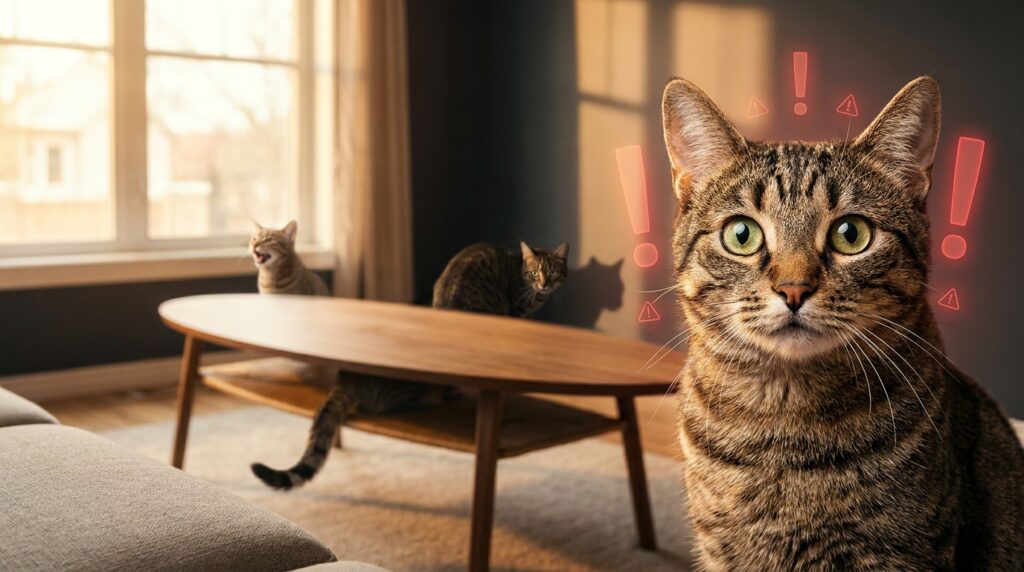
Cats are experts at hiding what they feel.
Unlike dogs, they don’t always make it obvious when something is bothering them. A cat can seem perfectly normal while quietly showing small changes in behavior that are easy to overlook.
That’s why paying attention to the little things can be so important.
Maybe your cat suddenly starts following you from room to room. Maybe they begin hiding more often, staring at a wall, meowing differently, or spending much more time sleeping than usual.
These behaviors don’t automatically mean something is wrong. But when a behavior suddenly changes, it’s worth paying attention.
Cats naturally enjoy quiet, private places.
It’s completely normal for a cat to occasionally disappear under a bed or curl up somewhere away from everyone.
But what if your normally social cat suddenly starts hiding for long periods?
A sudden increase in hiding can sometimes be associated with stress, fear, changes in the environment, or illness.
Think about what has changed recently.
Did you move furniture? Bring another animal into the house? Have visitors? Change your cat’s routine?
Even something that seems insignificant to you can feel very different to a cat.
If the hiding continues or appears alongside other unusual symptoms, it’s a good idea to speak with a veterinarian.
Your cat may have different sounds for different situations.
Some cats are naturally talkative, while others barely make a sound.
That’s why you should pay attention to what is normal for your particular cat.
If your cat suddenly becomes much louder, starts making unusual sounds, or seems to vocalize repeatedly without an obvious reason, something may have changed.
It could be attention-seeking, hunger, stress, or simply a new habit.
But persistent changes in vocalization can sometimes accompany discomfort or other health problems.
The key isn’t one unusual meow.
It’s a noticeable change from your cat’s normal behavior.
Cats sleep a lot.
Depending on age and individual habits, many cats spend a significant portion of their day sleeping.
So seeing your cat napping isn’t usually a reason to worry.
However, there is an important difference between a cat that loves sleeping and a cat that suddenly becomes much less active.
If your cat stops showing interest in favorite toys, food, interaction, or normal activities, that change deserves attention.
And there is one particular behavior that many cat owners dismiss as completely normal…
But when it suddenly appears or becomes much more frequent, it may be your cat’s way of telling you that something has changed.
One behavior that deserves special attention is a sudden change in grooming.
Cats are naturally very clean animals. They spend a large part of their day grooming their fur, and this is usually a normal part of their routine.
But what happens when your cat suddenly starts grooming much more than usual?
Excessive grooming can sometimes be associated with stress, skin irritation, allergies, parasites, or discomfort.
You may notice your cat repeatedly licking one specific area or even developing patches where the fur becomes thin.
On the other hand, a cat that suddenly stops grooming itself can also be showing that something has changed.
If your cat’s coat becomes unusually greasy, tangled, or unkempt, especially when this is a noticeable change from normal, it deserves attention.
Another important clue can be found in the litter box.
Changes in how often your cat urinates, how much they urinate, or how they behave while using the litter box shouldn’t simply be ignored.
You may notice your cat making repeated trips to the litter box, spending an unusually long time there, vocalizing, or suddenly avoiding the box.
These changes can have different causes, including stress, environmental changes, or medical problems.
Some urinary problems can become serious quickly, particularly in male cats.
If your cat is repeatedly trying to urinate but producing little or no urine, seek veterinary attention immediately.
Your cat’s eating habits can also tell you a lot.
A temporary change may happen for many harmless reasons, but a persistent loss of appetite or a significant increase in eating deserves attention.
The same applies to drinking.
If your cat suddenly begins drinking much more water than usual, or you notice a major change in their normal habits, make a note of it.
You don’t need to panic every time your cat behaves differently.
Instead, think about the bigger picture.
Has the change lasted for several days? Are there other symptoms? Is your cat acting differently overall?
Cats can’t tell us when something hurts.
That’s why behavior can sometimes provide an important clue.
The most useful thing you can do is learn your cat’s normal routine.
How much do they usually sleep? How often do they eat? How frequently do they use the litter box? How do they normally behave around you?
Once you know what’s normal, unusual changes become much easier to recognize.
And remember: one strange behavior doesn’t automatically mean your cat is sick.
But a sudden, persistent, or significant change should never be dismissed.
Your cat may not be able to say, “Something is wrong.”
But sometimes, their behavior is saying exactly that.
Pay attention. Your cat may be trying to tell you something.
Have you ever looked at your dog or cat sleeping and wondered why they chose…
You love your dog. You feed them, take them outside, buy them toys, and try…
Your dog may look happy, eat normally, and wag their tail every time you walk…
Pets cannot tell us when something is wrong. Instead, they communicate through changes in behavior,…
Your dog may look at you with those irresistible eyes while you're eating. One little…
Have you ever noticed that your dog seems to do the same strange thing every…
This website uses cookies.